
A friend joined a Bengaluru SaaS company last month at ₹15 lakh CTC. First salary credit hit her account: ₹1,00,308. She messaged me: “the offer said 1.25 a month, where did the rest go?”
Reasonable question. The offer letter said ₹15,00,000. The bank got ₹12,03,692 across the year. That’s a ₹2.96 lakh gap, and HR’s “you’ll get your full CTC” pitch never quite explains it. This article walks through every rupee of that gap, line by line, using the actual FY 2025-26 rules.
The math comes from the take-home salary calculator, which lets you swap your own CTC and basic percentage and see the result instantly. Numbers in this post are for ₹15L CTC, salaried, Karnataka, new tax regime, with basic at 50% of CTC (the New Wage Code 2019 minimum).
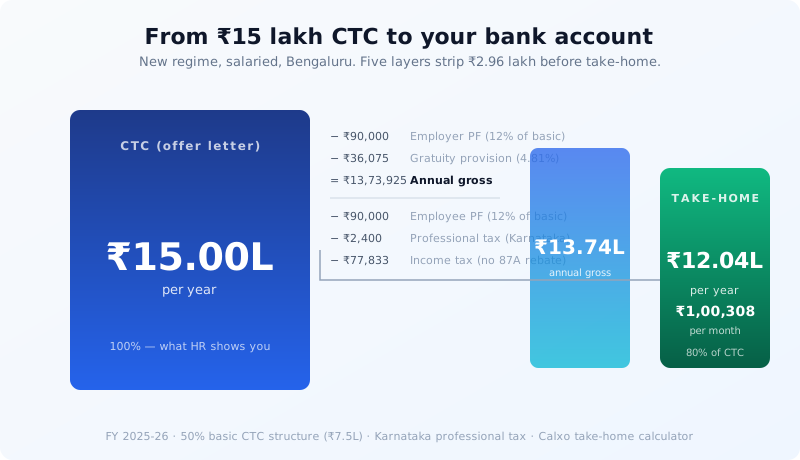
The five layers between offer letter and bank account
CTC stands for Cost To Company. It’s literally what the employer spends on you, not what they pay you. Two of those costs never show up on your payslip. Three more get deducted before the bank credit. The result is take-home.
Layer 1: Employer Provident Fund (₹90,000 on ₹7.5L basic) The employer contributes 12% of your basic salary to your EPF account. They count this as part of CTC, but it never reaches your bank. It lands in your EPF account, where it earns 8.25% in FY 2025-26 (notified by EPFO).
Layer 2: Gratuity provision (₹36,075 on ₹7.5L basic) The employer sets aside 4.81% of basic toward your future gratuity. This is an accounting provision, not a payment. You receive it only after 5 full years of service under the Payment of Gratuity Act, 1972. Leave before 5 years and the company keeps it.
After these two layers, the annual gross is ₹13,73,925. This is the number the payroll system actually pays out.
Layer 3: Employee Provident Fund (₹90,000) You also contribute 12% of basic to your EPF. This shows on your payslip as a deduction. Same EPF account as the employer’s contribution, so total ₹1.80 lakh per year goes into EPF on a ₹15L CTC.
Layer 4: Professional tax (₹2,400 in Karnataka) A small state-level tax. Maharashtra is ₹2,500/year, Karnataka and Tamil Nadu around ₹2,400, Delhi and Haryana don’t levy it. Treated as a deduction under section 16(iii) of the Income Tax Act.
Layer 5: Income tax (₹77,833 at ₹15L CTC under new regime) After the ₹75,000 standard deduction, taxable income is ₹12,98,925. That crosses the ₹12 lakh threshold so the ₹60,000 section 87A rebate stops applying. Slab tax computes to ₹74,839 under the new regime, plus 4% cess (₹2,994), gives ₹77,833. Marginal relief at ₹12L doesn’t trigger here because the slab tax is already lower than (taxable − ₹12L). Compare with ₹2.55 lakh under the old regime if no deductions are claimed.
Take-home after all five layers: ₹12,03,692 per year, which divides to ₹1,00,308 per month.
What CTC actually contains
The waterfall above tells you what gets stripped out. Here’s what the original ₹15 lakh is composed of in the first place.
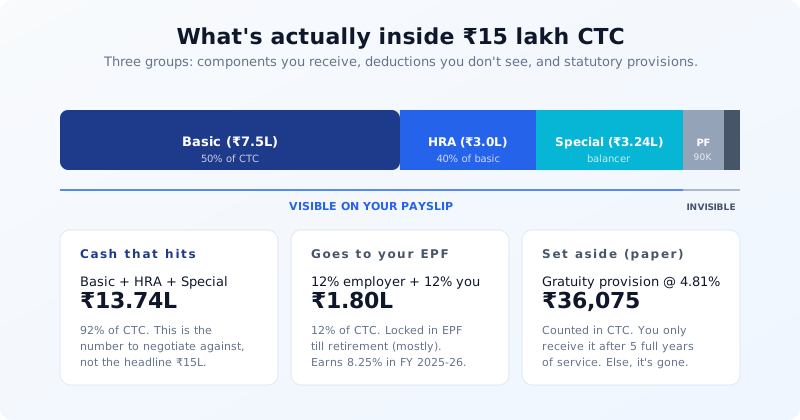
Basic salary (₹7.5 lakh, 50% of CTC)
The new Wage Code 2019 (notified, awaiting full implementation) requires basic to be at least 50% of total wages. Older offer letters often had basic at 35-40%, but new offers and renegotiated salaries are mostly aligned to the 50% rule. This single number drives almost every other calculation downstream:
- Provident fund contribution (12% of basic, both sides)
- Gratuity computation at exit (15 days of last basic per year of service)
- HRA exemption ceiling (50% in metros, 40% elsewhere)
- Bonus calculations (often capped at 8.33% of basic per Bonus Act)
HRA (typically 40% of basic = ₹3 lakh)
Companies set HRA between 40% and 50% of basic. Tax treatment depends on the regime: under the old regime, you can claim section 10(13A) exemption on HRA up to the minimum of three components (run the math on the HRA exemption calculator). Under the new regime, full HRA is taxable. So if you’re paying significant rent, the regime choice has real money attached.
Special Allowance (the balancer, ~₹3.24 lakh)
This is where companies put everything that’s not Basic, HRA, or specifically named. Fully taxable. Higher Special Allowance = lower PF/gratuity provisioning for the company, which is why some companies inflate it. Sometimes labelled “Flexi Pay”, “Other Allowance”, or “Adhoc”.
Employer PF (₹90,000) and Gratuity provision (₹36,075)
Already covered above. These are part of CTC but invisible on the payslip.
Worked example: ₹15 lakh CTC, new regime, salaried
Pulling it together for the Bengaluru SaaS engineer scenario.
| Step | Item | Amount |
|---|---|---|
| 1 | Annual CTC (offer letter) | ₹15,00,000 |
| 2 | − Employer PF (12% of ₹7.5L basic) | ₹90,000 |
| 3 | − Gratuity provision (4.81% of ₹7.5L basic) | ₹36,075 |
| 4 | = Annual gross (what payroll pays out) | ₹13,73,925 |
| 5 | − Employee PF (12% of basic) | ₹90,000 |
| 6 | − Professional tax (Karnataka) | ₹2,400 |
| 7 | − Income tax (new regime, ₹12.99L taxable) | ₹77,833 |
| 8 | = Take-home (annual) | ₹12,03,692 |
| 9 | Take-home (monthly) | ₹1,00,308 |
| 10 | Take-home as % of CTC | 80.2% |
The income tax in step 7 is the part most people miss. Standard deduction (₹75K) drops taxable income to ₹12,98,925. That’s just over the ₹12 lakh threshold, so the section 87A rebate (which would have zeroed the tax) stops applying. Slab tax under the new regime computes to ₹74,839; marginal relief doesn’t trigger because slab tax is already lower than (taxable − ₹12L); add 4% cess and total income tax is ₹77,833. Run your own CTC through the income tax calculator to see the exact number.
The take-home % drops sharply once your taxable crosses ₹12L. Below that, the 87A rebate keeps tax at zero. Above, every extra rupee of basic gets taxed.
How the regime choice changes take-home
For the same ₹15L CTC at 50% basic, here’s what the two regimes produce in monthly take-home:
| Strategy | Annual take-home | Monthly | Effective tax rate |
|---|---|---|---|
| New regime, no claimable deductions | ₹12,03,692 | ₹1,00,308 | 5.2% |
| Old regime, only ₹1.5L 80C claimed | ₹11,77,800 | ₹98,150 | 6.9% |
| Old regime, ₹3.75L deductions (80C + 80D + ₹2L home loan int.) | ₹12,16,800 | ₹1,01,400 | 4.4% |
| Old regime, ₹4.5L (above + HRA exemption ₹75K) | ₹12,38,160 | ₹1,03,180 | 2.9% |
| Old regime, ₹5.5L (HRA + home loan + 80C + 80D + NPS maxed) | ₹12,69,300 | ₹1,05,775 | 0.8% |
The cross-over for ₹15L CTC is around ₹3.75 lakh of total deductions. Below that, the new regime wins. Above that, old regime starts pulling ahead, but the cross-over usually requires HRA exemption + 80C maxed + 80D + ₹2L home loan interest claimed. Most salaried people don’t stack that high, so the new regime defaults to being the cheaper option. The full comparison is in the old vs new tax regime article.
Five things HR won’t tell you
1. Variable pay is in the CTC, but not guaranteed. If your offer says ₹15L CTC with ₹2L variable, the ₹13L is what you can plan against. The ₹2L is a target, paid only on company + individual performance. Plan your monthly budget against the fixed CTC.
2. Your effective hourly rate is much lower than ₹15L / 2080 hours. Take-home divided by actual working hours including overtime is the honest number. ₹1,00,308 monthly / ~190 hours = ₹528/hour. Less than the freelance rate most software engineers charge, which is the actual case for switching to consulting at higher seniority.
3. EPF contribution above ₹2.5 lakh annually is taxable. Budget 2021 introduced this. If your basic is high enough that 12% × basic crosses ₹2.5L per year (i.e., basic > ₹20.83L), the interest on the excess EPF gets taxed. Affects senior employees, not most.
4. Gratuity provision is real money you forfeit if you leave early. Companies count it in CTC, but you only see it after 5 years. Worth thinking about before optimising for the highest CTC offer with no signing bonus, especially for younger employees who switch jobs every 2-3 years.
5. Most CTC structures are reverse-engineered to favor the employer’s tax exposure, not your take-home. The choice of HRA percentage, special allowance vs basic, presence of LTA, food coupons, and NPS 80CCD(2) all affect the company’s books differently. If you’re at a senior level, ask HR for a flex-benefits letter. Most large employers (Infosys, TCS, Microsoft, Google, Flipkart) let you re-allocate annually.
How to actually increase take-home
Three legal levers, in rough order of impact:
Add employer NPS contribution under 80CCD(2). Up to 10% of basic for private sector (14% for government employees) is deductible in both regimes, including the new regime. On ₹7.5L basic, that’s ₹75,000 deductible. At the 15% marginal slab the ₹15L CTC sits in, that saves ₹11,700 of tax per year (more if you’re at 20% slab on a higher CTC). Many large employers offer this as a flexi-benefit reallocation: take ₹75,000 out of Special Allowance and put it as employer NPS contribution. Same CTC, lower tax, identical take-home plus growing retirement corpus.
Use food coupons (Sodexo / similar). ₹50 per meal × 22 working days = ₹1,100/month, fully tax-free under both regimes. Annual ₹13,200 of tax-free benefit. Tiny but it adds up over a career.
Optimise rent payment if you’re on old regime. If HRA exemption is your single largest deduction and you can structure rent payments cleanly (rent agreement, bank transfer, landlord PAN above ₹1L annual rent), this is a meaningful lever. If you’ve already shifted to new regime, this lever doesn’t exist.
The structural change to bigger take-home requires renegotiating the offer entirely (higher basic, lower variable, different employer NPS allocation) or switching to a job that pays more in cash and less in long-vest equity.
When the math breaks for higher CTCs
Take-home as a percentage of CTC at 50% basic, new regime, Karnataka professional tax:
| CTC | Annual take-home | Monthly | % of CTC |
|---|---|---|---|
| ₹6L | ₹5,11,170 | ₹42,598 | 85.2% |
| ₹10L | ₹8,67,150 | ₹72,263 | 86.7% |
| ₹15L | ₹12,03,692 | ₹1,00,308 | 80.2% |
| ₹25L | ₹19,17,170 | ₹1,59,764 | 76.7% |
| ₹50L | ₹35,67,360 | ₹2,97,280 | 71.3% |
| ₹1Cr | ₹66,80,000 | ₹5,56,667 | 66.8% |
Below ₹12.75L gross, the 87A rebate keeps the tax effectively zero, so take-home stays around 85%. Above that, the rebate stops covering the slab tax and take-home drops. By ₹1 crore CTC, surcharges (10% above ₹50L taxable, 15% above ₹1Cr) shave another 3-5 percentage points.
Frequently asked questions
Why is my actual take-home lower than this calculation?
Three usual reasons:
- Variable pay was deducted in advance from the CTC base used in your offer
- Insurance premiums (group health, term) deducted from gross
- Voluntary PF contribution above 12% (some employers offer this)
The take-home calculator handles the standard chain. For variable pay, deduct that from CTC first, then run.
Does this apply to government employees?
Mostly yes, but the basic + DA component is structured differently (DA is meaningful, often 50-60% of basic, and goes into PF base). Government employees also get NPS Tier I as default rather than EPF. The income tax slabs are identical regardless of sector.
What about freelancers and self-employed?
Different model entirely. No CTC, no employer PF, no gratuity. Income is your gross fees minus business expenses (or 50% deemed under 44ADA presumptive). The income tax calculator handles both salaried and presumptive computation.
How does take-home change if I shift to a 35-year tenure home loan?
Doesn’t directly, but the home loan EMI eats into discretionary spending. Plan against post-EMI take-home, not pre-EMI. Run the EMI calculator for the loan amount you’re considering, then subtract from this take-home to see actual monthly buying power.
Why did my company’s HR portal show a higher in-hand than this?
Common culprit: HR portal shows pre-tax monthly gross (₹13,73,925 / 12 = ₹1,14,494) rather than post-tax in-hand (₹1,00,308). Or they’re not including professional tax. Or they’re computing under old regime with assumed maxed deductions you may not actually claim. Verify by running both regimes on the calculator with your real declarations.
Is ₹15 lakh CTC a “good” salary in 2026?
Median salaried income in tier-1 cities for someone with 4-7 years of experience in IT/finance/product roles is around ₹12-18L CTC in 2026. ₹15L is roughly average for that experience band. For senior individual contributors at FAANG-tier companies in Bengaluru, ₹40-80L CTC is more typical. The take-home % drops noticeably above ₹15L because of how the new regime is structured.
What to actually do with this
Negotiate against gross, not CTC. The ₹15L CTC headline is misleading because ~₹1L of it never reaches you (employer PF + gratuity). Compare offers on annual gross or monthly take-home, not the CTC number HR puts on the offer letter.
Run your specific numbers. The take-home calculator handles your CTC, basic %, regime choice, and city’s professional tax. Compare both regimes via the income tax calculator before declaring to payroll.
Ask HR for the flexi-benefits structure. Most large Indian employers let you reallocate ₹40-80K annually between Special Allowance, NPS 80CCD(2), food coupons, and LTA. The default allocation is rarely optimal for the individual.
Plan against take-home, not CTC. Home loan eligibility, rent budget, monthly SIP, all of these should be computed against the ₹1,00,308 number, not the ₹1,25,000/month implied by the CTC. The EMI calculator and SIP calculator work against actual income.
Sources
- Income Tax Act 1961: Section 87A, Section 16, Section 80CCD(2), Section 115BAC
- Finance Act 2025: New regime slabs and 87A rebate amendment
- Employees’ Provident Funds and Miscellaneous Provisions Act 1952: 12% contribution rule
- Payment of Gratuity Act 1972: 4.81% provisioning convention, 5-year vesting
- Karnataka Tax on Professions, Trades, Callings and Employments Act 1976
- New Wage Code 2019: 50% basic-as-percentage-of-CTC requirement